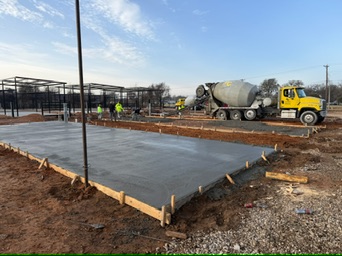
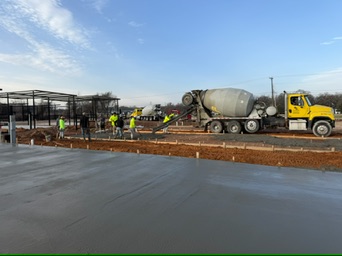
This Magnolia RV entry is the placement-day part of the project series. The source album shows a ready-mix truck on site, wood forms defining pad edges, crew members distributing and floating concrete, and multiple bays at different stages. It does not need a generic service pitch because the sequence itself is useful.
A repeated-pad project still needs a placement plan
The images show hand tools and a bull float working fresh concrete while nearby sections remain formed or at a different stage. Repeating the same pad shape can improve rhythm, but access, truck position, crew movement, posts, utilities, grade, and protection still need to be resolved for each placement.
The source does not give the number of pads poured that day, concrete quantity, thickness, reinforcement, mix, slope, joint layout, or weather. Those facts should come from tickets, plans, measurements, and the daily report rather than a count guessed from photographs.
Record what changes during the pour
A useful daily log notes truck sequence, start and finish times, weather, test or inspection activity, actual placement limits, delays, field changes, finish, joints, cure protection, and the area closed to traffic. That record helps the next phase begin from facts instead of memory.
For vehicle pads, the owner should also know how edges meet gravel or drives, where water leaves, which loads the design addresses, and who protects the surface until opening. Those requirements are part of the site and structural plan, not something a finishing photo can certify.
Move through the Magnolia RV series
Start with the layout and curved-curb note, use the Magnolia RV master case study for site context, and continue to the completion and handoff note.
The pages now function as a real sequence: layout and interfaces, placement-day operations, then cure, protection, and handoff. Each phase answers a different planning question.